Tree Cutting & Trimming Services
Professional Tree Cutting & Trimming Services in Somerville, MA
Trimming trees is an art and a science requiring a strong understanding of the biological and structural aspects of tree biology, including growth patterns and structural dynamics. Our team at Somerville Tree Masters has a trained staff of arborists with expertise to ensure that every tree is cut and trimmed correctly and safely for the owner. Our goal is to provide customers with quality tree trimming and cutting services that enhance the appearance, health, and longevity of their trees.
The most effective way to invest in your landscape is by regular pruning of your trees. A properly maintained tree is less susceptible to storm damage, disease, and pest infestation, has a longer lifespan, and adds value to your property and curb appeal. Poor pruning, however, can be detrimental to the long-term health and structural integrity of your trees. That’s why it is so important to hire a qualified arborist to perform the work; our certified arborists know exactly which areas to cut, when, and how to maximize the potential benefits for your trees.
We offer high-quality service to meet all of your tree trimming needs in Somerville. Whether you need routine maintenance pruning, corrective pruning due to the overgrowth of your trees, removal of damaged branches caused by storms, or specialized pruning (such as vista pruning or fruit tree care), we have the experience to meet and exceed your expectations. We don’t just trim your trees – we train and shape them to grow naturally and meet your unique urban landscape needs.
Expert Tree Pruning Techniques
Our approach to pruning is based upon the most current thinking in modern arboriculture. Our goal is to create long-term health through scientifically-based pruning methods, which promote the body of the tree to respond naturally to damage.
Precision Cuts and Standards
The Triple Cut Method: When pruning branches greater than 1 inch, we perform a three-step method of cutting the branch. The first cut is made in the middle portion of the branch about 6-12 inches from the trunk. A second cut is made on the opposite side of the first cut. The third cut is then completed to remove the final piece of the branch. This allows the tree to avoid stripping the bark when it falls off, thereby allowing the tree to seal the wound effectively.
Protecting the Anatomical Structure (Branch Collar): We protect the “branch collar,” the vital juncture where a branch attaches to the trunk. Avoiding flush cuts protects this vital structure and allows the tree to quickly isolate the damaged area and prevent further internal decay.
Thinning Versus Heading: As part of our commitment to providing safe and effective pruning services, we use thinning cuts (cuts that remove branches at their point of origin) to allow the tree to maintain its natural shape and provide adequate airflow. However, while heading cuts can be an effective way to structurally train certain types of trees, we do not recommend heading cuts for mature trees, as they will result in “lion’s tail” type growth that creates future hazards.
Targeted Pruning: Our team uses the research developed by Dr. Alex Shigo to identify the target area of each cut. Using this scientific method, we only make necessary cuts, and we always place our cuts in areas of the tree where it has the greatest biological advantage.
Species-Specific Shaping: We believe that a tree should look like a tree. Therefore, we only prune to enhance the natural form of each tree species in Somerville. We do not believe that topping or over-shaping your tree is worth the added stress and higher maintenance costs that these practices impose.
Preventative Wound Care: We recognize that large wounds created by pruning can be potential entry points for disease. To minimize the risk of infection, we attempt to keep all cuts under 4 inches in diameter. However, if a larger limb must be removed due to safety concerns, we will manage the site over multiple growing seasons to ensure the stability and continued health of the tree during the healing process.
Get A Free Quote
Crown Reduction And Thinning Services
We offer specialized pruning services to help maintain the health and safety of your Urban Forest:
Crown Cleaning: Our most basic maintenance service, crown cleaning, involves removing all dead, dying, or diseased limbs from your tree. It will greatly improve the overall look of your tree by removing hazardous conditions from within the canopy and limiting the spread of disease and insect infestation. We typically recommend this service for mature trees every 3-5 years.
Crown Thinning: If you want to decrease the density of your tree but don’t want to alter its shape, we offer a selective thinning process. This will allow for better air movement through the tree, improved sunlight penetration, and reduced wind resistance (“sail area”) during the high winds of New England storms. Trees with dense crowns (such as Maple) are ideal candidates for this service, and it will also greatly reduce the weight of the branches on structural limbs.
Crown Raising: For many of the densely populated neighborhoods of Somerville, maintaining enough vertical clearance for sidewalks, driveways, and buildings is critical. We carefully remove lower branches to increase clearance for pedestrians and vehicles. For younger trees, we do this gradually over several growing seasons to maintain a healthy “Live Crown Ratio” and ensure the structural integrity of the tree.
Crown Reduction: There may be times when a tree grows too large for its surrounding environment and needs to be reduced in size. Unlike the dangerous and damaging practice of “topping,” our certified arborists will make precise cuts to lateral branches that will assume terminal growth and preserve the natural shape of the tree. This is a very technically demanding operation that requires the training and experience of a certified arborist to protect the long-term health of the tree.
Structural Pruning: We consider Structural Pruning to be an investment in the future of your young tree. Identifying the dominant central leader of the tree and properly spacing the lateral branches as the tree grows creates a strong framework. This proactive care helps to prevent major branch failure and costly corrective removals down the road.
Deadwood Removal: While we provide a comprehensive pruning cycle, we also offer deadwooding as a targeted service. Removing dead, brittle branches removes the risk of injury from falling branches and limits the access point for wood-boring insects and decay. We recommend this as a periodic inspection of larger, mature trees between full maintenance cycles.
Deadwood Removal and Safety Pruning
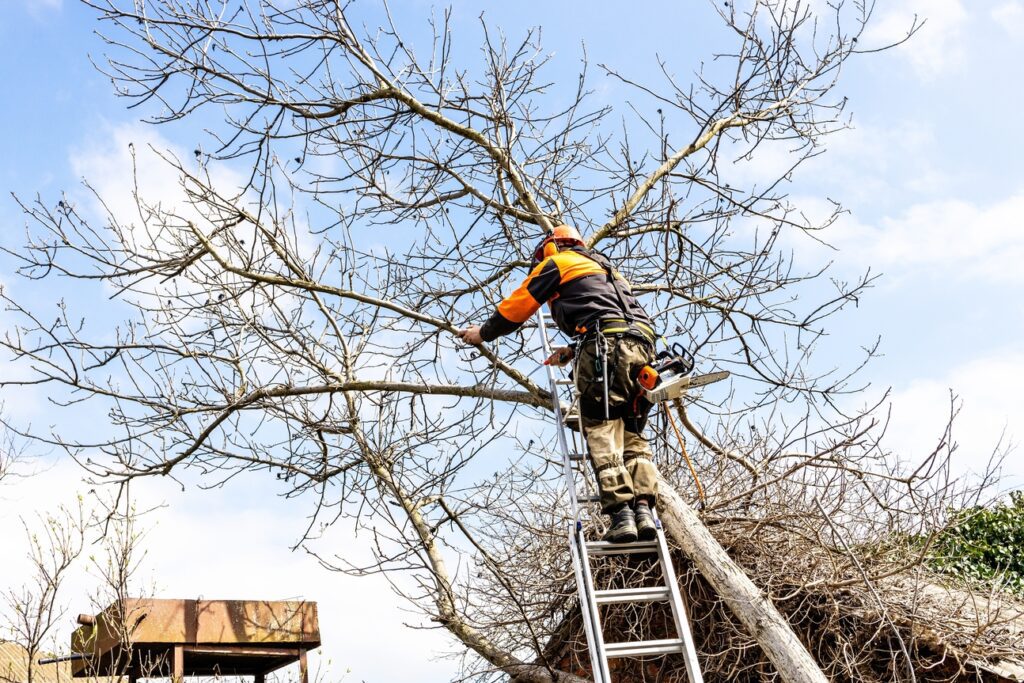
The risk associated with dead, dying, and damaged branches is so great as to make the removal of dead wood an essential part of maintaining trees safely in and around properties. Deadwood removal through our Safety Prune services identifies and removes any potentially dangerous branches prior to them falling and causing damage to persons and/or property. All of our trees are inspected on a systematic basis for evidence of rot, insect damage, disease, and structural flaws that may compromise the stability of individual branches.
Our Safety Prune service will eliminate branches with a small angle of attachment; cross branches that may rub against one another, creating stress at their point of contact; and branches that interfere with structures, vehicles, and pedestrian use areas. Additionally, we have trained arborists who will visually identify potential signs of impending branch failure and correct this issue prior to an emergency occurring.
Features of the Safety Prune Service:
- Identification of all possible hazards
- Preventative measures to prevent branch failure
- Protection of property
- Scheduling of regular inspections
- Ability to respond quickly to emergencies.
Structural Pruning For Young Trees
Early proper structural pruning lays the foundation for an ideal branching structure in young trees, and it is much less expensive than structural corrections that may be needed when these trees reach maturity. Young trees are pruned so that they develop one main trunk (leader), have well-spaced and developed scaffold branches, and eliminate any competing trunks or weakly attached branches. The most important part of this process is that it will greatly reduce the necessity for significant corrective pruning as the tree matures.
The method of structural pruning varies with the type of tree being pruned, the desired mature size, and the intended use of the tree within the landscape. Our trained arborist will evaluate which scaffold branches best meet their needs by assessing each branch for its location, its angle of connection to the rest of the tree, and how far apart each branch is to ensure a symmetrical and balanced canopy that will be able to support the mature weight of the tree. In addition, our trained arborist will assess and correct any potential structural problems that may arise from improper development, such as included bark, co-dominant stems, or excessive lean, to help ensure long-term stability of the tree.
Advantages of Structural Pruning:
- Develops strong branch architecture
- Prevents future structural problems
- Reduces the cost of maintenance over time
- Enhances mature tree stability
- Increases the overall value of the tree